
Home Loan Eligibility in India: The Complete Guide for Borrowers
Summary Box
Home loan eligibility is the lender’s judgement on how much you can safely repay. It is decided by six things: your net take-home income, your existing EMIs, your credit history, your age, your employment or business stability, and the property itself.
Two separate limits apply at the same time. The first is your repayment capacity, controlled by an internal lender rule called FOIR. The second is the Loan to Value (LTV) cap set by the Reserve Bank of India, which limits the loan against the value of the property.
Your final sanction is the lower of these two limits. This guide explains both, with worked examples, lender-wise criteria, document checklists and the exact reasons applications get rejected.
Table of Contents
- What Home Loan Eligibility Actually Means
- The Six Pillars of Home Loan Eligibility
- How Lenders Calculate Your Eligibility: The Six-Step Method
- FOIR: The Rule That Decides Your Real Borrowing Limit
- LTV and Margin Money: The RBI Rule You Cannot Negotiate
- Regulatory Framework: What Is Law and What Is Lender Policy
- How Income Is Assessed for Different Applicant Types
- Age and Loan Tenure: The Hidden Eligibility Lever
- Credit Score and Credit History
- Property Eligibility: The Factor Borrowers Forget
- Co-Applicants and Joint Home Loans
- Lender-Wise Eligibility Criteria
- Eligibility by Income Level: Indicative Illustrations
- Real Borrower Scenarios
- Documents Required to Prove Eligibility
- Common Reasons Home Loan Applications Are Rejected
- How to Improve Your Home Loan Eligibility
- Myths and Facts About Home Loan Eligibility
- The Journey from Application to Disbursement
- Frequently Asked Questions
- Glossary of Key Terms
- Editorial Notes and Limitations
Key Takeaways
- LTV caps are RBI regulations. FOIR limits, minimum income and minimum credit score are individual lender policies and vary from bank to bank.
- Lenders use your net take-home income, not your gross salary, when calculating repayment capacity.
- Your age decides your maximum tenure, and tenure directly decides how much loan a given EMI can support.
- No article, tool or calculator can confirm eligibility. Only a lender’s credit appraisal can. Everything here is educational and indicative.
- The property must clear legal and technical verification. A strong financial profile cannot rescue a property with a defective title.
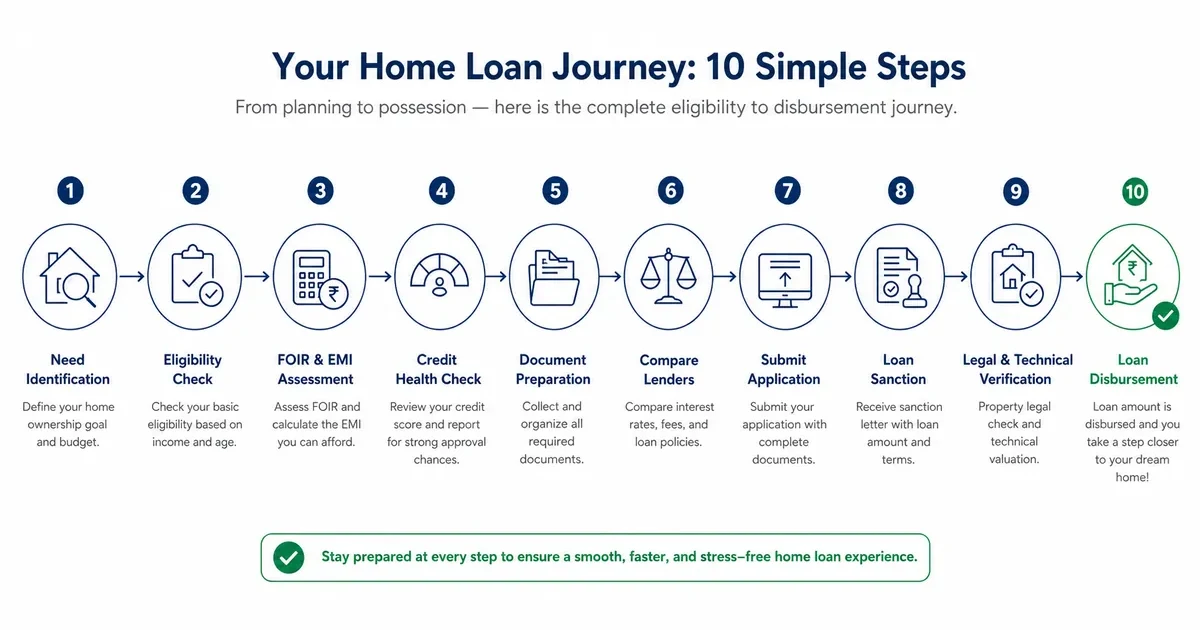
Before the detailed rules, here is the complete path from deciding you need a home loan to receiving the funds.
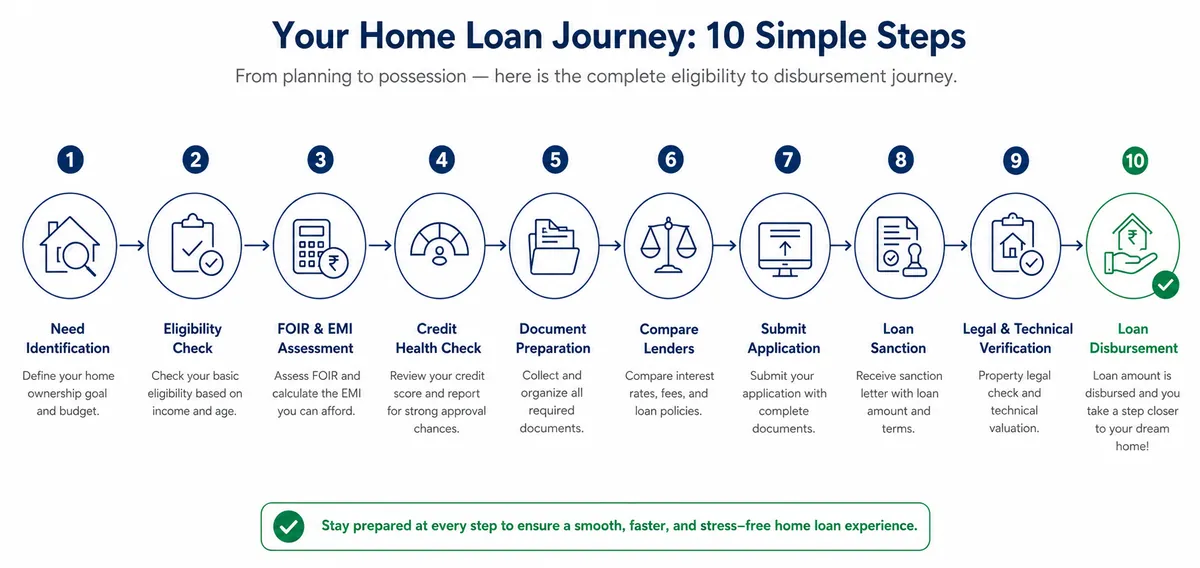
With the full journey in view, the next section unpacks what eligibility actually means at the first of those ten stages.
What Home Loan Eligibility Actually Means
Definition
Definition Block
Home Loan Eligibility is the set of criteria a lender uses to assess a borrower’s capacity to repay and intent to repay. Capacity is measured through income, existing debt, age and employment stability. Intent is measured through credit history and past repayment behaviour.
A home loan is a secured credit product. The residential property you buy is pledged to the lender as collateral. Because the loan runs for fifteen to thirty years, the lender is not only checking whether you can pay today. It is checking whether you can keep paying for two or three decades.
This is why eligibility assessment is stricter and slower than for a personal loan or a credit card. The lender is underwriting a very long relationship.
Why Lenders Assess Eligibility So Carefully
Housing loans are long-tenure, low-margin products. A single default can wipe out the profit from many good loans. Lenders therefore build a mathematical safety buffer into every sanction.
RBI data has consistently shown housing loans carrying the lowest gross non-performing asset (GNPA) ratios among retail credit products, generally below 2 per cent. That discipline is partly borrower behaviour and partly the result of conservative eligibility rules applied at the time of sanction.
Understanding these rules before you apply saves you from two painful outcomes: applying with a profile that will be rejected, or committing to a property you cannot ultimately finance.
Eligibility, Approval, Sanction and Disbursement Are Not the Same
Borrowers often use these four words interchangeably. Lenders do not. Confusing them is one of the most common causes of a failed property purchase.
| Stage | What It Means | What It Does Not Mean |
|---|---|---|
| Eligibility check | An indicative estimate of how much you may be able to borrow, based on income and obligations | It is not a commitment from any lender |
| In-principle approval | A preliminary decision based only on your income and credit history | It does not cover the property; it can still fail at the legal or technical stage |
| Sanction letter | A conditional written commitment stating the approved amount, rate and tenure, generally valid for a limited period such as three to six months | It is not money in your account; conditions must still be satisfied |
| Disbursement | Actual release of funds to the builder or seller after the loan agreement is executed | It may be released in stages for under-construction property |
Warning Box
An in-principle approval or pre-approval validates you, not the property. Final disbursement remains fully contingent on legal title verification and technical valuation. Never pay a large token amount to a seller assuming your pre-approval guarantees funding.
Related reading
- Read our complete Home Loan Process Guide →
- Understand your Sanction Letter →
The Six Pillars of Home Loan Eligibility
With those four stages clearly separated, the next question is what the lender actually examines when it forms its judgement. Every lender in India, whether a public sector bank, a private bank or a housing finance company, assesses the same six pillars. What differs is how strictly each one is applied.
Table: Core Eligibility Factors
| Factor | What the Lender Is Testing | How It Affects Your Loan Amount | Who Sets the Rule |
|---|---|---|---|
| Net monthly income | Baseline repayment capacity | Directly sets your maximum EMI ceiling | Individual lender policy |
| Existing debt obligations | Surplus income left after current EMIs | Every existing EMI reduces your new loan capacity rupee for rupee | Individual lender policy |
| Credit score and history | Willingness and discipline in repaying | Affects approval, interest rate premium and sometimes the LTV offered | Lender policy, using bureau data |
| Applicant age | How many earning years remain | Decides maximum tenure, which decides how much loan an EMI can support | Individual lender policy |
| Employment or business stability | Risk of income disruption | Poor stability can cause deferral or rejection despite good income | Individual lender policy |
| Property value and legal standing | Quality of the security | Sets the RBI-mandated ceiling on the loan against property value | RBI regulation (LTV), lender policy (property acceptability) |
Income
Income is the starting point, but the lender uses a specific version of it. For salaried applicants, the assessment is based on net take-home salary evidenced by payslips and bank credits. For self-employed applicants, it is based on declared profit in income tax returns and audited financials.
Existing Obligations
Every running EMI reduces the room available for a new home loan EMI. This includes car loans, personal loans, consumer durable loans, existing home loans and, in most underwriting models, credit card outstandings.
Credit History
Bureau reports show not just a score but a behaviour pattern: delayed payments, settled accounts, written-off accounts, and how often you have recently applied for credit.
Age
Most lenders require the loan to be fully repaid by the time you reach retirement age, generally 60 for salaried applicants and 65 or 70 at loan maturity depending on the lender. This is what silently limits older applicants.
Employment Stability
Banks commonly look for a minimum of two years of total work experience and at least one year with the current employer. This is standard industry practice rather than a regulation, and the exact requirement varies by lender.
Property
Even a borrower with excellent income and credit will be declined if the property has an unclear chain of title, unapproved construction, illegal deviations, or falls outside approved municipal limits.
Expert Tip
Borrowers spend most of their preparation effort on income documents and almost none on property documents. In practice, property-related problems cause a large share of late-stage failures, when you have already paid a token amount and a login fee. Ask the seller or builder for the complete document set before you apply.
Related reading
- Explore our Property Legal Verification Guide →
How Lenders Calculate Your Eligibility: The Six-Step Method
Knowing which six pillars matter is only half the picture. What converts them into a rupee figure is a fixed sequence of calculations, and it is the same sequence in almost every underwriting system. Understanding it lets you predict your own outcome fairly closely.
Step 1 — Establish Net Monthly Income
The lender begins with take-home pay after statutory deductions such as provident fund, professional tax and income tax. Gross salary is not used.
Variable components like bonuses, incentives and overtime are treated cautiously. Conservative public sector banks often exclude variable pay entirely, while some housing finance companies and NBFCs may average it and consider a portion of it. This treatment varies by lender.
Step 2 — Total Up Existing Obligations
All running EMIs are added together. Credit card outstandings are typically converted into a notional EMI — underwriters commonly assign a theoretical EMI of about 5 per cent of the outstanding balance. This is an industry practice, not a regulation, and the percentage can differ between lenders.
Step 3 — Apply the FOIR Ceiling
The lender applies its internal FOIR limit to your net income to arrive at your total permissible EMI outflow. Existing EMIs are then subtracted, and what remains is your available home loan EMI.
Step 4 — Determine Maximum Tenure from Age
Maximum tenure is generally the lower of the lender’s cap (often 30 years) and the number of years remaining until the lender’s maximum age at loan maturity.
Step 5 — Convert EMI Capacity into a Loan Amount
The available EMI is converted into a principal amount using the interest rate and the maximum tenure. Mathematically this is the present value of that EMI stream.
Step 6 — Apply the RBI LTV Cap
Finally, the lender checks the property value. Even if your income supports a larger loan, the sanction cannot exceed the RBI-mandated LTV ratio for that loan bracket.
Your final sanction is the lower of the Step 5 figure and the Step 6 figure.
The flowchart below maps this six-step sequence from net income through to your final indicative sanction.
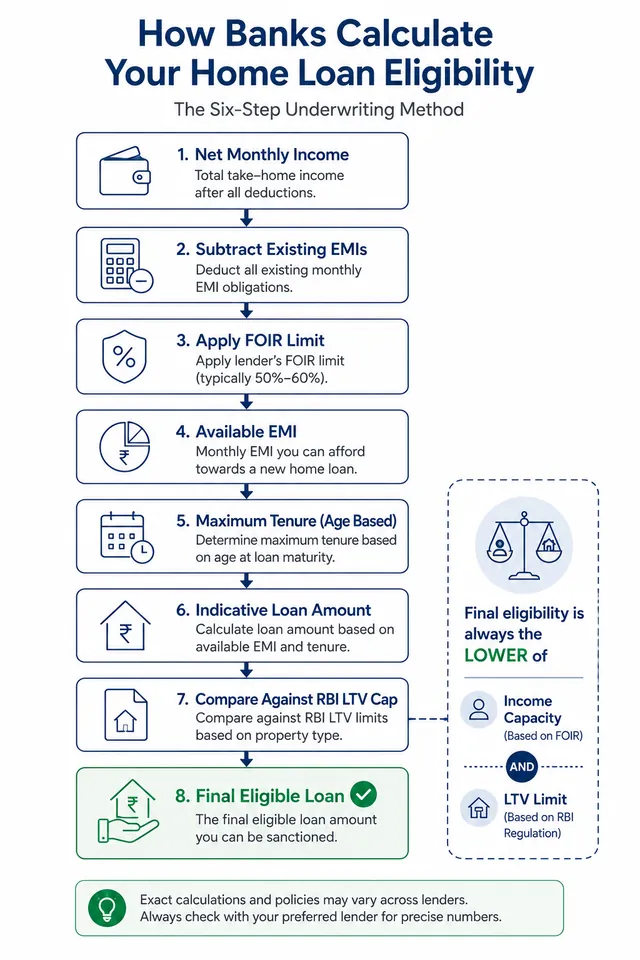
Once you can see the full sequence, the calculator below lets you run your own numbers through it.
Home Loan Eligibility Calculator — Coming Soon
Enter your net monthly income, existing EMIs, age and expected interest rate to get an indicative maximum loan amount and EMI. This tool is in development. Once live, this notice is replaced with the working calculator embed — the surrounding editorial text does not change.
Related reading
- Calculate your EMI →
- Compare Home Loan Interest Rates →
FOIR: The Rule That Decides Your Real Borrowing Limit
Of those six steps, Step 3 is where most applications are quietly won or lost. It deserves a section of its own.
What FOIR Is
Definition Block
FOIR (Fixed Obligation to Income Ratio) is the maximum permissible percentage of your net monthly income that can be consumed by total debt servicing, including the proposed home loan EMI. It exists to prevent borrowers from becoming over-leveraged.
FOIR is the single most misunderstood number in Indian housing finance. It is not an RBI rule. It is an internal commercial policy set by each lender, and it is the reason two banks can quote you very different loan amounts on the same salary.
Formula Box
FOIR Formula
FOIR (%) = [ (Existing EMIs + Proposed EMI) / Net Monthly Income ] × 100Variables
- Existing EMIs — all running loan instalments, plus a notional EMI on credit card outstanding
- Proposed EMI — the instalment on the home loan you are applying for
- Net Monthly Income — take-home pay after PF, professional tax and TDS
Note: Gross income is never used in this calculation.
The Most Common FOIR Mistake
Many borrowers calculate their affordability on gross salary. On a ₹1,00,000 gross salary with ₹15,000 of statutory deductions, the lender works with ₹85,000. At a 50 per cent FOIR, that is a difference of ₹7,500 in monthly EMI capacity — which can translate into several lakhs of loan eligibility.
Table: Typical FOIR Tiers by Income Band
| Net Monthly Income | Typical FOIR Allowed | What This Means in Practice |
|---|---|---|
| Below ₹30,000 | Around 40% | Tightest band; small existing EMIs have a large impact |
| ₹30,000 to ₹75,000 | Around 50% | The most common band for salaried borrowers |
| ₹75,000 to ₹1,50,000 | Varies significantly by lender | Some lenders stay at 50%, others move towards 60% |
| Above ₹1,50,000 | Up to 60–65% | Higher surplus income justifies a higher ratio |
Source: Standard banking and housing finance industry practice. These are not RBI-mandated figures. Each lender publishes its own internal matrix, and these tiers are revised commercially without public announcement. Treat this table as indicative and confirm with the lender.
Why the tiers rise with income: A borrower earning ₹25,000 who spends 60 per cent on EMIs is left with ₹10,000 for all living expenses. A borrower earning ₹3,00,000 who spends 60 per cent is left with ₹1,20,000. The absolute residual income, not just the ratio, is what protects the lender.
Worked Example: How FOIR Sets Your Ceiling
Example Box — FOIR in Action
Profile: Net monthly income ₹60,000. Existing car loan EMI ₹8,000. Credit card outstanding ₹40,000.
Step 1 — Notional credit card EMI: ₹40,000 × 5% = ₹2,000 Step 2 — Total existing obligations: ₹8,000 + ₹2,000 = ₹10,000 Step 3 — FOIR ceiling at 50%: ₹60,000 × 50% = ₹30,000 Step 4 — Available home loan EMI: ₹30,000 − ₹10,000 = ₹20,000
Learning outcome: The card balance the borrower thought was irrelevant reduced the available EMI by ₹2,000. Clearing that ₹40,000 balance before applying would have restored roughly ₹2 lakh to ₹2.5 lakh of eligibility, depending on tenure and rate.
This borrower may be eligible for a loan in that range, subject to the lender’s own FOIR policy, credit assessment and property valuation.
Exceptions to FOIR Limits
Exceptions are occasionally granted, but they are discretionary and never guaranteed. Reported practice includes some relaxation for government employees, applicants offering substantial liquid collateral, and borrowers opting for structured step-up EMI plans early in their careers.
Certain housing finance companies also apply higher FOIR tolerance — reportedly up to around 65 to 70 per cent — for premium professional profiles such as doctors and chartered accountants. These are commercial programmes that change without notice.
FOIR Calculator — Coming Soon
Enter your net monthly income, existing loan EMIs and credit card outstanding to see your current FOIR percentage and a comfortable / moderate / stretched risk indicator. This tool is in development. Once live, this notice is replaced with the working calculator embed — the surrounding editorial text does not change.
Related reading
- Read our complete FOIR Guide →
- How to fix a rejection caused by high FOIR →
LTV and Margin Money: The RBI Rule You Cannot Negotiate
FOIR decides what your income can carry. The second ceiling has nothing to do with your income at all — it is fixed by regulation and applies to the property.
What LTV Is
Definition Block
Loan to Value (LTV) is the ratio of the sanctioned loan amount to the value of the property. Unlike FOIR, LTV caps are RBI regulations and apply to all regulated lenders. No lender can exceed them, regardless of how strong your income is.
Table: RBI LTV Caps
| Loan Amount | Maximum LTV | Minimum Margin Money From You |
|---|---|---|
| Up to ₹30 lakh | 90% | At least 10% |
| Above ₹30 lakh and up to ₹75 lakh | 80% | At least 20% |
| Above ₹75 lakh | 75% | At least 25% |
Source: RBI LTV norms for individual housing loans. Regulation — applies to all regulated lenders.
Margin Money and What the Loan Does Not Cover
Definition Block
Margin money is the mandatory down payment you must fund from your own resources to bridge the gap between the property cost and the lender’s maximum funding.
Borrowers routinely underestimate their cash requirement because they forget that stamp duty and registration charges are generally not funded by the home loan. LTV is applied to the property or agreement value, and these transaction costs sit outside it.
Example Box — The Real Cash You Need
Property agreement value: ₹60 lakh Applicable LTV: 80% (loan falls in the ₹30–75 lakh bracket) Maximum bank funding: ₹48 lakh Margin money required: ₹12 lakh Plus stamp duty, registration and incidental charges: an additional amount payable from own funds, which varies by state
Learning outcome: A borrower who budgeted only ₹12 lakh will fall short at registration. Always plan for margin money plus transaction costs.
Warning Box
100 per cent financing of a home purchase is not permitted. Any offer promising full funding of property cost including registration should be treated with extreme caution and verified directly with the lender.
FOIR and LTV are easy to confuse because both cap your loan — the comparison below sets them side by side.
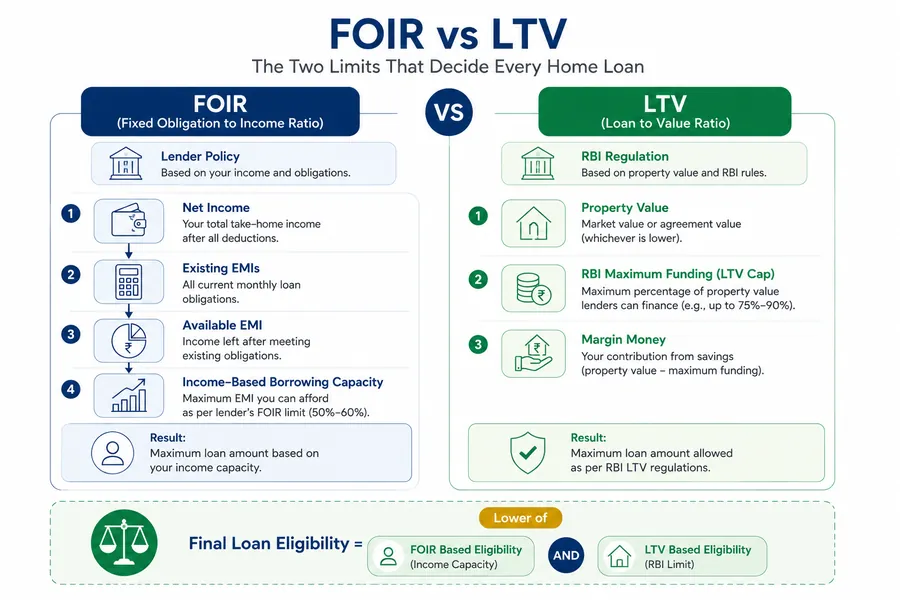
With both limits clear, the calculator below applies the LTV side of this comparison to your own property value.
Maximum Loan (LTV-Based) Calculator — Coming Soon
Enter your property’s agreement value and expected stamp duty to see the maximum amount a bank can fund and the total own-funds you would need. This tool is in development. Once live, this notice is replaced with the working calculator embed — the surrounding editorial text does not change.
Related reading
- RBI LTV Guidelines and Margin Money Explained →
Regulatory Framework: What Is Law and What Is Lender Policy
LTV is one of several rules that bind every lender equally. Separating those rules from the ones each lender writes for itself is the most useful habit a borrower can develop, because only one of the two categories is negotiable.
This distinction matters. Regulations are binding on every lender. Policies change quietly and differ between institutions.
Table: Key Regulations Affecting Home Loan Borrowers
| Regulation | Issuing Authority | Key Provision | What It Means for You | Category |
|---|---|---|---|---|
| LTV Ratio Norms | RBI | LTV capped at 90% up to ₹30 lakh, 80% for ₹30–75 lakh, 75% above ₹75 lakh | Sets your mandatory minimum down payment; prevents 100% financing | Regulation |
| External Benchmark Linked Lending | RBI | New floating rate retail loans must be linked to an external benchmark. In practice, most commercial banks use the RBI Repo Rate, producing what is called the Repo Linked Lending Rate or EBLR | Repo rate changes are transmitted to your loan more transparently and on a defined reset cycle | Regulation |
| Risk Weights on Housing Loans | RBI | Risk weights tied to LTV ratios rather than loan ticket size | Lower LTV lending is cheaper for banks, which can support better pricing | Regulation |
| Foreclosure Charge Restrictions | RBI | Banks are restricted from levying foreclosure penalties on floating rate term loans to individual borrowers | You can prepay or transfer a floating rate loan without a prepayment penalty | Regulation |
| Credit Information Reporting Frequency | RBI | Lenders must report credit information to bureaus on a fortnightly basis, effective 1 January 2025 | Your repayments and loan closures reflect in your credit report faster. Explained in full in the Credit Score section | Regulation |
| Release of Property Documents | RBI | Original property documents must be returned and charges removed within 30 days of full repayment, with compensation where the delay is the lender’s fault | Protects you at the end of the loan. Explained in full in the Property Eligibility section | Regulation |
Definition Block — Repo Rate and EBLR
The Repo Rate is the rate at which the Reserve Bank of India lends short-term funds to commercial banks. It is set by the RBI’s Monetary Policy Committee.
The External Benchmark Lending Rate (EBLR) is the interest rate a bank charges on a floating rate retail loan, built as the external benchmark plus the bank’s own spread. Where the chosen benchmark is the repo rate, the loan is commonly described as repo-linked.
The benchmark is set by the RBI. The spread added on top is the individual bank’s commercial decision, which is why two banks quoting against the same repo rate can still charge you different rates.
Editorial Note on Verification
Circular numbers, issue dates and amendment status should be verified against the current RBI Master Directions before you rely on them for a transaction. Regulations are periodically amended, superseded or clarified. This table reflects the position recorded in our research and is reviewed periodically.
What Is Not a Regulation
The following are individual lender policies or industry practice, not RBI rules, and they vary from lender to lender:
- FOIR limits and income tier bands
- Minimum credit score requirements
- Minimum income requirements
- Maximum age at loan maturity
- Treatment of variable pay, bonuses and rental income
- Processing fees and their waivers
- Whether cash salary is acceptable
- The spread added above the external benchmark
Related reading
- Explore our CIBIL Score Guide →
How Income Is Assessed for Different Applicant Types
Regulation sets the outer boundaries. Within those boundaries, the single biggest variable is how your income reaches you and how well it is documented. The same ₹1,00,000 monthly income is treated very differently depending on how it is earned and documented.
Salaried Applicants
Assessment is based on payslips, salary credits into a bank account, and Form 16. Because income is documented and predictable, salaried assessment is the fastest and most standardised.
The critical requirement is that salary must be credited to a bank account. Cash salary, even if genuine and consistent, cannot be verified through the standard process.
Self-Employed Professionals
Doctors, chartered accountants, architects and similar professionals are assessed on income tax returns with computation of income, and audited financial statements. Many lenders operate dedicated professional programmes with more flexible terms, because these profiles have historically shown stable, growing income.
Professional qualification proof, such as a degree certificate or a professional council registration, is typically required.
Business Owners and Self-Employed Non-Professionals
Assessment is based on ITRs, audited balance sheets, profit and loss statements, GST returns, and current account operations. Business vintage matters heavily — lenders commonly look for three or more years of established operations.
There is an unavoidable tension here. Business owners often optimise their declared profit for tax efficiency, but lenders can only lend against declared profit. Low declared income means low eligibility.
Variable Income
Bonuses, incentives, commissions and overtime are treated inconsistently across the market. Conservative public sector banks may exclude them entirely. Some housing finance companies and NBFCs may average them over a period and consider a portion. Always ask a lender directly how it treats your variable component.
Rental and Other Income
Rental income from other properties, dividend income and regular consultancy fees can strengthen your profile, but generally only when they are verifiable through your ITR and Form 26AS. A rent agreement alone is usually insufficient.
Note that expected or projected rental income from the property you are buying is treated cautiously and is not universally accepted. Practice varies by lender.
Table: Income Sources and How Lenders Treat Them
| Income Source | Primary Evidence Required | Typical Lender Treatment |
|---|---|---|
| Fixed salary (banked) | Payslips, salary credits, Form 16 | Fully considered |
| Variable pay, bonus, incentive | Payslips, Form 16, appointment letter | Treatment varies widely; often discounted or excluded |
| Business profit | ITR, audited P&L and balance sheet, GST returns | Considered on declared profit; vintage matters |
| Professional income | ITR with computation, professional registration | Fully considered; often on preferential programmes |
| Rental income from other property | Registered rent agreement plus ITR and Form 26AS | Partially considered when documented |
| Pension income | Pension slips, bank credits | Considered; tenure limited by age |
| Cash income, undocumented | Not evidenced through banking channels | Generally not accepted by mainstream banks |
| Agricultural income | ITR, land records | Treatment varies significantly by lender |
Table: Applicant Types at a Glance
| Applicant Type | Core Income Proof | Common Challenge | Typical Lender Preference |
|---|---|---|---|
| Salaried, private sector | Payslips, Form 16, bank statements | Frequent job changes | All lenders |
| Salaried, government | Payslips, service record | Generally fewer obstacles | All lenders; some offer schemes |
| Self-employed professional | ITR, audited financials, qualification proof | Fluctuating annual income | Banks and HFCs, often on special programmes |
| Business owner | ITR, GST, current account statements, entity proof | Low declared profit; vintage requirements | Banks for established businesses; HFCs for others |
| Informal or cash income earner | Assessed income through field verification | No Form 16 or ITR trail | Affordable housing finance companies |
| Pensioner | Pension credits | Very limited tenure | Select lenders, usually with a co-applicant |
Common Mistake
Self-employed applicants often approach a bank immediately after a year of low declared profit caused by tax planning. Because lenders average and scrutinise the last two to three years of ITRs, a single weak year can reduce eligibility significantly. Plan your ITR filings at least two years ahead of a planned property purchase.
Related reading
- Home Loan Eligibility for Self-Employed Borrowers →
- Learn about Home Loan Documents →
Age and Loan Tenure: The Hidden Eligibility Lever
Documented income tells the lender how much you can pay each month. How long you are allowed to keep paying is decided by something you cannot document at all.
Age does not directly reduce your loan amount. It reduces your tenure, and tenure reduces your loan amount.
Most lenders require the loan to be fully repaid by the time you reach a defined maximum age at maturity — commonly 60 or 65 for salaried applicants and up to 70 for some lenders and profiles.
Why Tenure Matters So Much
The same EMI supports a very different loan amount depending on how long you can repay.
Table: Illustrative EMI per ₹1 Lakh of Loan
| Tenure | At 8.5% | At 9.0% | At 9.5% |
|---|---|---|---|
| 15 years | ₹985 | ₹1,014 | ₹1,044 |
| 20 years | ₹868 | ₹900 | ₹932 |
| 25 years | ₹805 | ₹839 | ₹874 |
| 30 years | ₹769 | ₹805 | ₹841 |
These interest rates are illustrative only and are used to demonstrate the mathematics. They are not quoted rates and do not reflect any lender’s current pricing. Home loan rates are linked to external benchmarks and change over time. Always confirm the applicable rate with your lender.
Example Box — The Same EMI, Two Different Ages
Two borrowers can both afford an EMI of ₹25,000. At an illustrative 9 per cent rate:
- Borrower A, age 30, can take a 30-year tenure. ₹25,000 ÷ ₹805 per lakh ≈ ₹31 lakh
- Borrower B, age 45, is limited to a 15-year tenure (to age 60). ₹25,000 ÷ ₹1,014 per lakh ≈ ₹24.6 lakh
Learning outcome: Identical repayment capacity, but roughly ₹6 lakh difference in indicative eligibility, purely because of age.
Expert Tip
A longer tenure raises your eligibility but increases total interest paid over the life of the loan. Many borrowers take the maximum tenure to secure the sanction, then prepay aggressively. Because RBI restricts foreclosure penalties on floating rate loans to individuals, this strategy carries no prepayment penalty on such loans. Industry experience suggests the average 20-year home loan in India is actually closed in around 7 to 9 years.
Credit Score and Credit History
Income and age establish your capacity. Your credit report is where the lender looks for evidence of intent — the record of how you have handled borrowed money before.
Which Bureau Matters
India has multiple credit bureaus, including TransUnion CIBIL, Experian, Equifax and CRIF High Mark. CIBIL is the primary benchmark used by the large majority of Indian lenders, but your report may differ slightly across bureaus because not every lender reports to every bureau at the same time.
Definition Block
The CIBIL Score is a three-digit number ranging from 300 to 900, generated by TransUnion CIBIL, summarising your credit behaviour. A score of 750 and above is widely treated as the industry benchmark for favourable pricing.
Table: Credit Profile Bands and Typical Lender Response
| Score Band | How Lenders Generally Read It | Typical Consequence |
|---|---|---|
| 750 and above | Prime borrower | Best advertised rates; scope to negotiate processing fees |
| 700 to 749 | Acceptable, close to prime | Approval likely; pricing may carry a small premium |
| 650 to 699 | Elevated risk | Enhanced scrutiny; possible lower LTV, higher rate, or a co-applicant requirement |
| Below 650 | High risk | Frequently declined by mainstream banks; some HFCs may consider at risk-adjusted pricing |
| “NH” or “-1” (no history) | Thin file, no track record | Routed through specialised underwriting; may need higher margin money or a salary account relationship |
Source: Standard industry practice. These bands are lender policy, not regulation. Each lender sets its own cut-offs, and several do not publicly disclose them.
Red Flags That Commonly Cause Rejection
- Recent defaults, write-offs or settled accounts
- Days Past Due (DPD) markers on credit cards or loans within the last 12 months
- Credit card utilisation persistently near the limit
- A cluster of recent loan applications, each creating a hard enquiry
- Guarantor liability on a loan that has gone bad
The Soft Enquiry Versus Hard Enquiry Distinction
Myth Box
Myth: Checking your own credit score reduces it.
Fact: Checking your own score is a soft enquiry and has no impact. What lowers your score is multiple hard enquiries — checks initiated by lenders when you formally apply. Applying to six banks in one week creates six hard enquiries and signals credit hunger.
How to Strengthen Your Credit Profile Before Applying
- Close small unsecured personal loans and consumer durable EMIs
- Bring credit card utilisation below roughly 30 per cent of the limit
- Never miss a payment in the 12 months before applying
- Download your own report and dispute any erroneous entries with the bureau
- Apply to a shortlist of two or three lenders, not to every lender available
Regulatory Update — How Often Your Credit Data Is Now Updated
Effective 1 January 2025, the RBI requires all banks and NBFCs to report your loan and credit card repayment data to credit bureaus (such as CIBIL and Experian) every 15 days, instead of once a month. Lenders must update this information on the 15th and the last day of each month, and submit it within seven days of the reporting fortnight.
This means your credit report will reflect your recent payments, loan closures or new borrowing much faster, helping you benefit from improved credit behaviour sooner when applying for a home loan.
Two practical caveats. The rule governs how quickly lenders must submit data. Bureaus still need a few days to process that data and regenerate your score, so the improvement is faster than before but not instant. Lenders and bureaus are also permitted to agree on intervals shorter than 15 days.
Category: RBI regulation. Verified against RBI Credit Information Reporting directions, effective 1 January 2025.
Warning Box
Correcting an error in a bureau report is not instant. Disputes take time to be investigated and reflected. If you spot an incorrect default or an account that is not yours, start the dispute process well before you apply.
Related reading
- Explore our CIBIL Score Guide →
- Does a 650 score mean rejection? →
Property Eligibility: The Factor Borrowers Forget
Everything so far has been about you. The lender now runs a second, entirely independent assessment — of the asset that will secure the loan.
The property is not incidental to the loan. It is the security. Lenders run two independent checks.
Legal Verification
An advocate empanelled by the lender examines the ownership history of the property.
Definition Block
A Legal Search Report is the title verification conducted by a lender-empanelled advocate, tracing the property’s ownership chain — typically covering a period of 13 to 30 years depending on the lender and the state.
Technical Verification
Definition Block
Technical Valuation is a physical inspection by a lender-empanelled engineer, confirming the property’s boundaries, construction quality, approved plan compliance and market value.
The technical valuation can come in below the agreed sale price. When that happens, the LTV is applied to the lower valuation, and your margin money requirement rises. This is one of the most common late-stage shocks in a property transaction.
Common Property Issues That Reduce or Eliminate Eligibility
- Unclear or broken chain of title in a resale transaction
- Construction deviating from the approved plan
- Missing occupancy or completion certificate
- Property located outside approved municipal or development authority limits
- Encroachment or boundary disputes
- Agricultural land not converted for residential use
- Builder or project not approved by the lender
Expert Tip
Many lenders maintain a list of approved projects. If your chosen project is already approved by a lender, the legal and technical process is usually faster and smoother. Ask the lender for its approved project list before finalising a property.
Table: Property Document Requirements
| Transaction Type | Core Documents Required |
|---|---|
| Under-construction, builder purchase | Allotment letter, builder buyer agreement, approved plan, project approvals, payment receipts |
| Resale property | Complete chain of title deeds, previous sale deeds, approved plan, latest property tax receipts, society NOC where applicable |
| Self-construction | Land title documents, approved building plan, construction cost estimate from an approved valuer |
| Balance transfer | Foreclosure letter from existing lender, loan statement of account, list of documents held by the current financier |
Your Right When the Loan Ends — Return of Original Property Documents
You hand your original title documents to the lender at the start of the loan. RBI rules govern when you get them back.
Under RBI rules, once you fully repay your home loan, your bank or NBFC must return your original property documents and remove any registered charge within 30 days. If the lender delays this process through its own fault, it must compensate you ₹5,000 for every day of delay beyond the 30-day limit.
There is one important exception. If the lender has lost or damaged your original documents, it is granted an additional 30 days — 60 days in total — to help you obtain certified duplicates at its own cost before the daily compensation begins.
Scope and limits. This protection applies to loans the RBI classifies as personal loans to individuals, which includes individual housing loans. Property mortgaged for a business or commercial loan is outside its scope. Delays caused by the borrower — for example, not collecting the documents when called — do not trigger the compensation.
Category: RBI regulation. Verified against RBI responsible lending conduct directions on release of property documents.
Related reading
- Property Legal Verification Checklist →
- Under-construction vs Resale: What Changes in Your Loan →
Co-Applicants and Joint Home Loans
If the six-step calculation has left you short of the amount you need, the most effective remedy is usually not a different lender. It is a second applicant.
What a Co-Applicant Is
Definition Block
A co-applicant is an additional borrower on the same loan, usually an immediate family member, whose income can be combined with yours to enhance eligibility and who shares full legal responsibility for repayment.
Why Adding a Co-Applicant Works Mathematically
FOIR is a ratio. Adding an earning co-applicant increases the denominator — combined net income — which immediately increases the total EMI the lender will permit. It is the single most effective way to raise eligibility.
Example Box — Clubbing Income
Applicant alone: Net income ₹55,000. At 50% FOIR, EMI capacity is ₹27,500. With earning spouse: Combined net income ₹90,000. At 50% FOIR, combined EMI capacity is ₹45,000.
At an illustrative 9 per cent over 20 years, the available EMI rises from ₹27,500 to ₹45,000 — moving indicative eligibility from roughly ₹30 lakh to roughly ₹50 lakh.
Learning outcome: The couple may be eligible for a substantially higher amount, subject to both applicants’ credit profiles and the lender’s assessment. Note that a co-applicant’s poor credit score can also pull the application down.
Non-Earning Co-Applicants
A non-earning spouse can be added as a co-applicant or co-owner. This does not increase eligibility, because there is no income to club. It is generally done for ownership, succession or stamp duty reasons, and because several lenders require all property co-owners to be co-applicants on the loan.
Some lenders also offer concessional interest rates when a woman is the primary applicant or co-owner. This is a lender-level commercial offering and the terms vary.
Responsibilities to Understand Before Signing
- A co-applicant is equally liable for the full outstanding, not for a proportionate share
- The loan appears on the co-applicant’s credit report and reduces their own future borrowing capacity
- Removing a co-applicant later is difficult and generally requires the lender’s approval and a fresh eligibility assessment
Warning Box
Adding a co-applicant with a poor credit history can turn an approvable application into a rejected one. Check both applicants’ bureau reports before applying.
Related reading
- Step-by-Step Guide to Adding a Co-Applicant →
Lender-Wise Eligibility Criteria
The rules described so far are common to the whole market. What changes from one institution to the next is where each threshold is set. Different lenders operate different risk appetites. The table below summarises publicly available and commonly reported criteria.
Table: Bank and HFC Eligibility Matrix
| Lender | Age (Min / Max at Maturity) | Stated Minimum Monthly Income | Maximum Tenure | Maximum LTV | Indicative Minimum CIBIL | Notable Programmes |
|---|---|---|---|---|---|---|
| SBI | 18 / 70 years | Not publicly disclosed | Up to 30 years | Up to 90%, subject to RBI slabs | 700 (preferred) | Concessions for women borrowers; scheme for defence personnel |
| HDFC Bank | 21 / 65 years | ₹10,000 (reported) | Up to 30 years | Up to 90%, subject to RBI slabs | Not publicly disclosed | Step-up repayment facility for young professionals |
| ICICI Bank | 21 / 65 years | ₹25,000 (metros) | Up to 30 years | Up to 90%, subject to RBI slabs | Not publicly disclosed | Pre-approved sanctions for salary account holders |
| Kotak Mahindra Bank | 21 / 65 years | ₹20,000 (metros) | Up to 20 years | Up to 80% | 750 (preferred) | Best rate tiers linked to 750+ score and salary account |
| Bajaj Housing Finance | 23 / 70 years | Not publicly disclosed | Up to 30 years | Up to 90%, subject to RBI slabs | 720 (preferred) | Customised LTV and FOIR for doctors and chartered accountants |
| PNB Housing Finance | 21 / 70 years | ₹15,000 | Up to 30 years | Up to 90%, subject to RBI slabs | Not publicly disclosed | Affordable housing segment programme |
| LIC Housing Finance | 21 / 65 years | ₹15,000 | Up to 30 years | Up to 90%, subject to RBI slabs | 700 (preferred) | Programme for borrowers receiving salary in cash |
| Aavas Financiers | 21 / 65 years | Assessed income basis | Up to 25 years | Up to 80% | No minimum history mandated | Semi-urban self-construction and informal income assessment |
All figures are individual lender policies, not regulations, and are subject to unannounced revision. Several lenders do not publicly disclose minimum income or minimum credit score thresholds; these are marked as not publicly disclosed rather than estimated. Confidence level: Medium. Verify directly with the lender before relying on any figure.
FOIR limits have been deliberately excluded from this table because most lenders do not publish them. Industry practice generally falls in the 40 to 65 per cent range depending on income tier, as explained in the FOIR section above.
The grid below places these criteria side by side for faster scanning across all eight lenders.
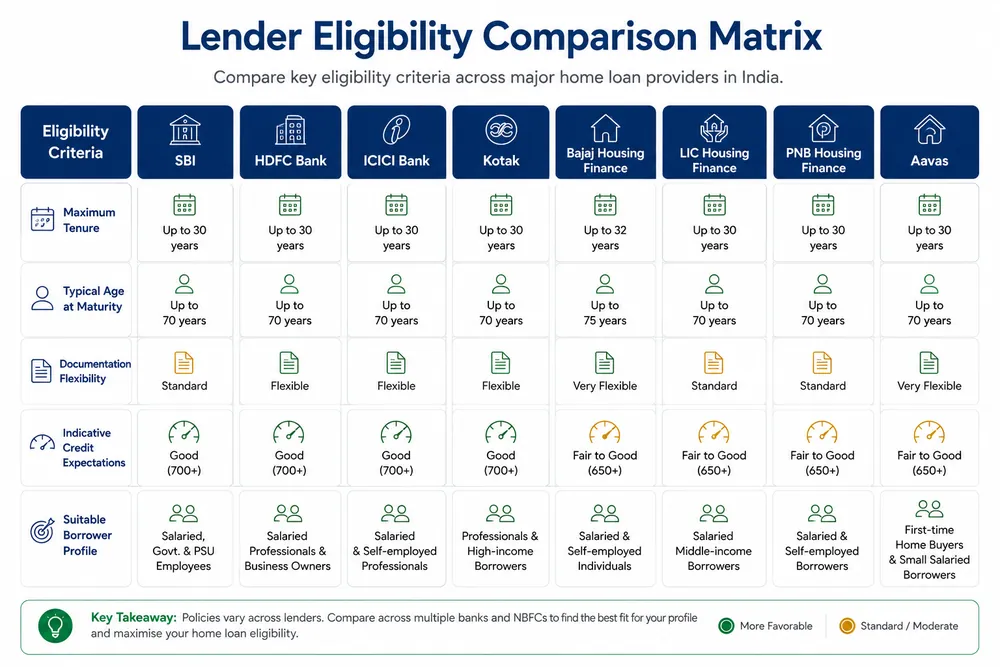
Beyond these individual figures, a broader pattern separates banks from housing finance companies, covered next.
Banks Versus Housing Finance Companies
This is a distinction most content ignores, and it materially changes your outcome.
| Dimension | Banks (especially public sector) | Housing Finance Companies and NBFCs |
|---|---|---|
| Income documentation | Strict; formal proof preferred | More flexible; some assess informal income |
| Variable pay treatment | Often excluded | More often partially considered |
| FOIR approach | Generally conservative | Can be more flexible for premium profiles |
| Geographic reach | Strong in urban and metro markets | Often stronger in semi-urban and tier-3 markets |
| Interest rate | Typically lower for prime profiles | Often higher, reflecting risk-adjusted pricing |
| Best suited for | Documented salaried and established businesses | Informal income, self-construction, thin-file borrowers |
Expert Tip
If a leading bank declines you, that does not mean no lender will lend. It usually means your profile does not match that lender’s programme. A housing finance company with an informal-income programme may assess the same profile very differently — but usually at a higher interest rate. Weigh that cost carefully.
Related reading
Eligibility by Income Level: Indicative Illustrations
To see how the tiers and the arithmetic combine, it helps to run the same calculation across a range of salaries. These illustrations use standard FOIR tiers, a 20-year tenure and an illustrative 9 per cent interest rate. They assume no existing EMIs.
Table: Indicative Eligibility by Net Monthly Income
| Net Monthly Income | Typical FOIR Applied | Available EMI | Indicative Loan Amount (20 years, 9% illustrative) |
|---|---|---|---|
| ₹25,000 | ~40% | ₹10,000 | Approximately ₹11 lakh |
| ₹50,000 | ~50% | ₹25,000 | Approximately ₹28 lakh |
| ₹75,000 | ~50% | ₹37,500 | Approximately ₹42 lakh |
| ₹1,00,000 | ~50–60%, varies by lender | ₹50,000 to ₹60,000 | Approximately ₹56 lakh to ₹67 lakh |
| ₹1,50,000 | Up to ~60–65% | ₹90,000 to ₹97,500 | Approximately ₹1 crore or more |
How to read this table: These figures move substantially with tenure, interest rate and existing EMIs. A borrower with a longer tenure will see a higher figure. A borrower with an existing car loan will see a lower one. These are illustrations of the arithmetic, not offers, and any actual sanction depends on the lender’s own assessment of your complete profile and the property.
Warning Box
Many online eligibility calculators assume that most or all of your salary can go towards an EMI. That produces figures far above what any lender will actually sanction. Always check whether a calculator applies a realistic FOIR limit.
Real Borrower Scenarios
Income tables assume a clean profile with no complications. Real applications rarely arrive that way. These four scenarios illustrate how the same set of rules produces very different outcomes. They are educational illustrations, not offers or predictions of approval.
Scenario 1 — Young Salaried IT Professional in a Metro
Profile: Age 26. Net monthly income ₹85,000. Existing car loan EMI ₹12,000. CIBIL 780.
Assessment:
- FOIR applied: 50% → total permissible EMI ₹42,500
- Less existing car loan EMI: ₹42,500 − ₹12,000 = ₹30,500 available
- Maximum tenure: up to 30 years, given the applicant’s age
- Indicative loan amount: roughly ₹35 lakh to ₹40 lakh, depending on the applicable interest rate
What this scenario teaches: The car loan is costing this borrower a meaningful amount of home loan eligibility. Prepaying it would release the full ₹42,500 of capacity. The wide range in the indicative amount also shows how sensitive the outcome is to the interest rate.
Scenario 2 — Self-Employed Retail Trader in a Tier-2 City
Profile: Age 42. Declared net profit ₹6 lakh per annum on ITR. No existing EMIs. CIBIL 710.
Assessment:
- Assessed net monthly income: ₹50,000
- FOIR applied: 50% → ₹25,000 available EMI
- Maximum tenure: restricted to around 18 years, because the loan must close by age 60 with most lenders
- Indicative loan amount: roughly ₹24 lakh to ₹26 lakh
What this scenario teaches: Despite having no existing debt, age has compressed the tenure and therefore the loan amount. Had this borrower been 30 with the same income, a 30-year tenure would have supported a considerably larger loan. It also shows why declared ITR profit — not actual business turnover — is what matters.
Scenario 3 — Medical Professional
Profile: Age 35. Net monthly income ₹2.5 lakh. Existing personal loan EMI ₹40,000. CIBIL 810.
Assessment:
- Housing finance companies often treat qualified doctors as a premium profile and may allow FOIR up to around 65%
- Total permissible EMI: ₹2,50,000 × 65% = ₹1,62,500
- Less existing personal loan EMI: ₹1,62,500 − ₹40,000 = ₹1,22,500 available
- Indicative loan amount: upwards of ₹1.3 crore, subject to the LTV cap of 75% for loans above ₹75 lakh
What this scenario teaches: At this loan size, the binding constraint is likely to be LTV, not FOIR. To borrow ₹1.3 crore at 75% LTV, the property would need to be valued at roughly ₹1.73 crore or more, and the borrower would need to arrange margin money of over ₹43 lakh plus transaction costs.
Note on confidence: Preferential professional programmes with higher FOIR tolerance are commercial offerings that lenders alter without public announcement. Confidence level: Low to Medium. Confirm directly with the lender.
Scenario 4 — Informal, Cash-Earning Skilled Worker
Profile: Age 38. Earnings around ₹35,000 per month, largely in cash. Credit report shows “NH” (no history).
Assessment:
- Mainstream banks are likely to decline, because there is no banked salary trail and no Form 16
- Affordable housing finance companies may conduct a field income assessment rather than relying on formal documents
- FOIR typically capped conservatively at around 40%: ₹14,000 available EMI
- Indicative loan amount: approximately ₹10 lakh to ₹12 lakh, generally at a risk-adjusted higher interest rate
What this scenario teaches: Informal income is not automatically disqualifying, but it changes which lenders will consider you and at what price. Building a six to twelve month record of consistent bank deposits before applying materially improves the assessment.
Note on confidence: Assessed-income underwriting varies significantly between HFCs and even between branches, based on regional portfolio performance. Confidence level: Low. These programmes are not publicly documented in detail.
Related reading
- Home Loan on Cash Salary Without ITR →
Documents Required to Prove Eligibility
Whichever scenario resembles yours, the lender will only act on what you can evidence. Preparing documents in advance is the fastest way to reduce processing delays.
The infographic below summarises what each applicant type needs, ahead of the detailed checklists that follow.
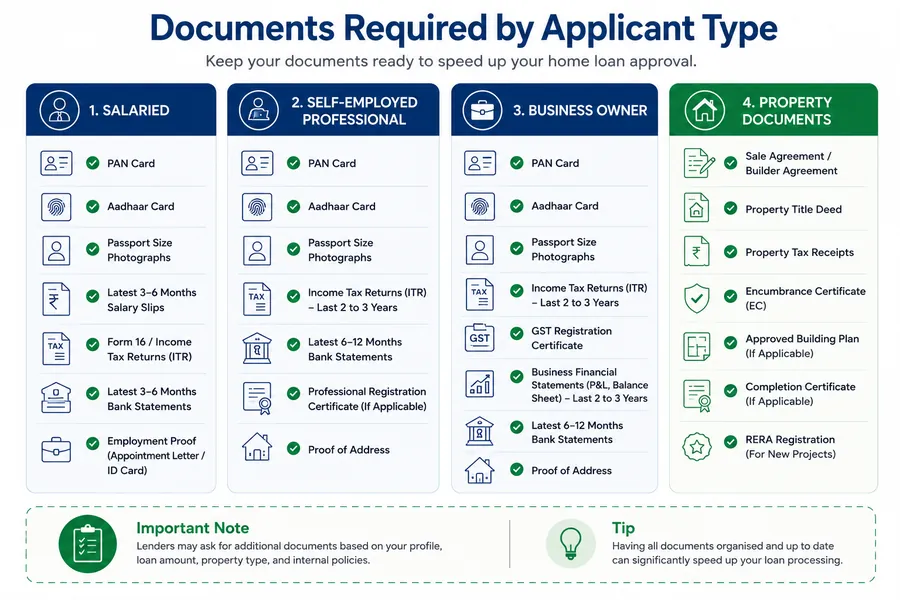
Use the visual summary as a quick reference, and the checklists below for the complete, printable detail.
Checklist: Identity and Address (All Applicants)
- ✓ PAN card
- ✓ Aadhaar card
- ✓ Passport-size photographs
- ✓ Additional address proof as required by the lender
- ✓ Signature verification as required by the lender
Checklist: Salaried Applicants
- ✓ Last three months’ salary slips
- ✓ Last six months’ bank statements of the salary account
- ✓ Form 16 for the last two years
- ✓ Appointment letter or employment certificate
- ✓ Employee ID card
Checklist: Self-Employed Professionals
- ✓ Income tax returns for the last three years with computation of income
- ✓ Audited balance sheet and profit and loss statement
- ✓ GST returns where applicable
- ✓ Professional qualification certificate and council or association registration
- ✓ Last six to twelve months’ bank statements, both personal and business
Checklist: Business Owners
- ✓ Entity proof — Certificate of Incorporation, partnership deed, or Udyam registration
- ✓ Income tax returns for the last three years with computation
- ✓ Audited financial statements
- ✓ GST returns
- ✓ Current account statements for the last twelve months
- ✓ Proof of business vintage, generally three years or more
Checklist: Property Documents
- ✓ Allotment letter or builder buyer agreement
- ✓ Complete chain of title deeds for resale property
- ✓ Approved building or floor plan
- ✓ Latest property tax receipts
- ✓ Occupancy or completion certificate where applicable
- ✓ Society NOC where applicable
Checklist: Balance Transfer Cases
- ✓ Foreclosure letter from the existing lender
- ✓ Loan statement of account showing the repayment track record
- ✓ List of original property documents held by the current financier
- ✓ Sanction letter of the existing loan
Downloadable Checklist — Coming Soon
A printable, mobile-friendly PDF of this document checklist, segmented by applicant type, is in production. Once available, this notice is replaced with a working download button.
Expert Tip
Document requirements are not fully standardised. Every lender adds its own items. Ask your specific lender for its current checklist rather than assuming a generic list is complete — a single missing document can delay a sanction by weeks.
Related reading
- Learn about Home Loan Documents →
Common Reasons Home Loan Applications Are Rejected
Understanding what a complete file looks like is useful. Understanding why complete files still get declined is more useful.
Table: Rejection Reasons and What They Mean
| Category | Specific Reason | Why the Lender Rejects | Can It Be Fixed |
|---|---|---|---|
| Financial | Existing EMIs push FOIR above the limit | No surplus income to service a new EMI | Yes — prepay or close existing loans |
| Financial | High credit card utilisation | Treated as active debt through a notional EMI | Yes — clear outstandings before applying |
| Financial | Declared income too low for the loan sought | Repayment capacity insufficient | Yes — add a co-applicant or reduce loan size |
| Credit | Recent default, write-off or settlement | Signals repayment risk | Partially — requires time and a clean record |
| Credit | DPD markers within the last 12 months | Recent delinquency is heavily weighted | Yes, over time |
| Credit | Too many recent hard enquiries | Signals credit hunger | Yes — wait and apply selectively |
| Employment | Frequent job changes within 12 months | Income stability concern | Yes — complete a year with the current employer |
| Employment | Insufficient total work experience | Below the lender’s minimum threshold | Yes, with time |
| Documentation | Cash salary with no corresponding bank credits | Income cannot be verified | Partly — build a banking trail, or approach an HFC |
| Documentation | Missing or inconsistent ITR filings | Income cannot be substantiated | Yes — regularise filings |
| Property | Defective or broken chain of title | Security is unenforceable | Often not, for that property |
| Property | Construction deviating from approved plan | Legal and resale risk | Usually not |
| Property | Outside approved municipal limits | Falls outside lending policy | No, for that property |
| Property | Valuation lower than the agreed price | Loan is capped on the lower value | Partly — increase margin money |
| Age | Applicant close to retirement without a co-applicant | Tenure too short to support the EMI | Yes — add a younger earning co-applicant |
Why a “good” FOIR can still be rejected
Borrowers are often confused when a 55 to 60 per cent FOIR is declined. FOIR is only one of six pillars. A comfortable FOIR does not override a recent credit default, an unverifiable income source, or a property with a legal defect. Eligibility is assessed as a whole, not as a single number.
The infographic below condenses these six rejection categories into a quick visual reference.
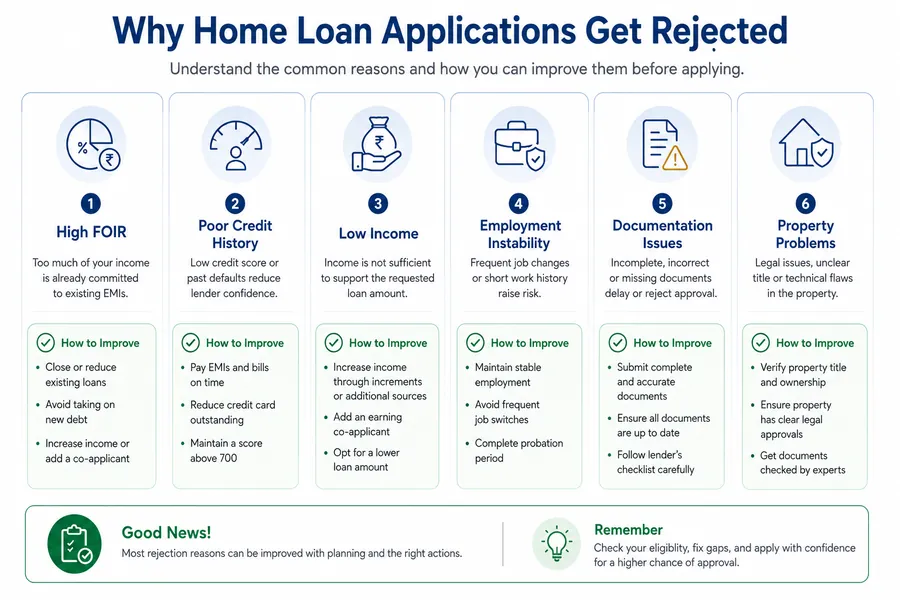
Most of these causes are fixable — the next section ranks the most effective ways to improve your eligibility.
Related reading
- How to Fix a Loan Rejection Due to High FOIR →
- What to do after a home loan rejection →
How to Improve Your Home Loan Eligibility
Most of those rejection reasons are fixable, and several can be fixed before you apply rather than after you are declined.
Table: Improvement Strategies Ranked by Impact
| Strategy | How It Works | Typical Impact | Time Needed |
|---|---|---|---|
| Add an earning co-applicant | Increases the income denominator in the FOIR calculation | High | Immediate |
| Close existing loans | Frees up EMI capacity rupee for rupee | High | Immediate to short |
| Clear credit card outstandings | Removes the notional EMI (about 5% of balance) from obligations | Medium to high | Immediate |
| Choose a longer tenure | Reduces the EMI per lakh borrowed | High | Immediate |
| Improve your credit score | Improves approval odds and pricing tier | Medium to high | 6 to 12 months |
| Declare verified additional income | Rental, dividend or consultancy income supported by ITR and Form 26AS | Medium | Depends on documentation |
| Increase your margin money | Reduces the loan needed, easing both FOIR and LTV | Medium | Depends on savings |
| Complete a year with your current employer | Removes the job stability objection | Medium | Up to 12 months |
| Opt for a step-up repayment plan | Lower EMIs initially, rising later as income grows | Medium | Immediate, where offered |
| Regularise ITR filings | Establishes a documented income record | Medium to high | 1 to 2 years |
The Trade-off You Must Understand
Two of the most effective strategies carry a real cost.
Longer tenure raises eligibility but increases total interest paid over the loan’s life. Step-up repayment raises eligibility today by assuming your income will rise. If that income growth does not materialise, the higher EMIs in later years become a genuine strain.
Neither is wrong. Both require you to be honest with yourself about your income trajectory.
The decision tree below turns the ranked strategies above into a step-by-step path you can follow immediately.
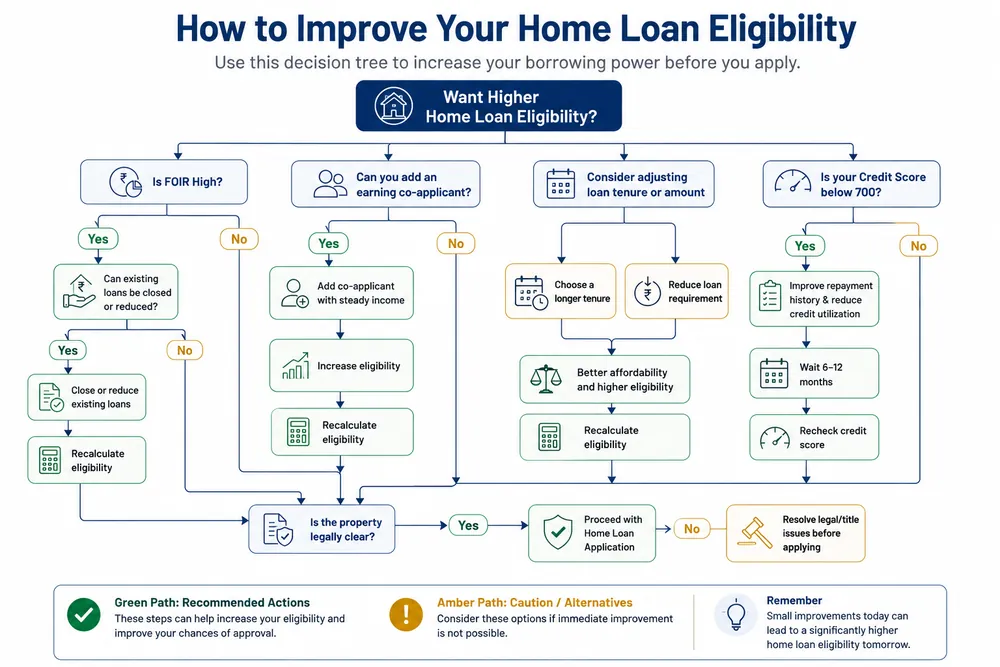
Whichever branch applies to you, avoid the common mistake below before you act on it.
Common Mistake
Borrowers often apply to several lenders at once hoping one will approve. Each formal application creates a hard enquiry, and a cluster of enquiries lowers your score and signals distress. Fix the underlying issue first, then apply selectively to two or three lenders whose programmes match your profile.
Related reading
- What happens to my eligibility if I prepay my car loan →
- Read our complete FOIR Guide →
Myths and Facts About Home Loan Eligibility
Some of the most damaging delays come not from a weak profile but from a confidently held belief that turns out to be wrong.
| Common Belief | The Actual Position |
|---|---|
| “Checking my credit score will lower it” | Self-checks are soft enquiries with no impact. Only lender-initiated hard enquiries affect your score. |
| “I can get a loan covering the full property cost plus registration” | RBI caps LTV. You must fund at least 10 to 25 per cent of property value from your own resources, plus stamp duty and registration. |
| “A pre-approval guarantees disbursement” | Pre-approval validates your income and credit only. It remains contingent on legal and technical clearance of the property. |
| “Older people cannot get home loans” | Lenders do lend to older applicants, including pensioners with adequate pension income, sometimes up to age 70 or beyond at maturity — but tenure is short, so the EMI is high. |
| “Banks look at my gross salary” | Lenders use net take-home income after PF, professional tax and TDS. |
| “A high salary alone guarantees a large loan” | Existing obligations, age-limited tenure and the LTV cap can each reduce the outcome independently of salary. |
| “All lenders apply the same rules” | LTV caps are uniform because they are regulatory. FOIR, minimum income, minimum score and income treatment differ substantially between lenders. |
| “One rejection means I cannot get a home loan” | A rejection reflects a mismatch with that lender’s programme. Another lender with a different programme may assess the same profile differently, often at a different price. |
The Journey from Application to Disbursement
With the myths cleared and your profile prepared, what remains is the process itself. Understanding the sequence helps you anticipate where delays occur.
- Document preparation — assemble KYC, income and property documents
- Application submission — formal application with the login or processing fee
- Credit appraisal — verification of income, employment and bureau report
- In-principle approval — preliminary decision based on your financial profile
- Legal verification — title chain examined by the lender’s empanelled advocate
- Technical valuation — physical inspection and valuation by the lender’s empanelled engineer
- Sanction letter — conditional written commitment with amount, rate and tenure
- Loan agreement and mortgage creation — execution of documents, including MODT where applicable
- Disbursement — release of funds to the builder or seller, in stages for under-construction property
The flowchart below visualises these nine stages and flags exactly where delays typically occur.
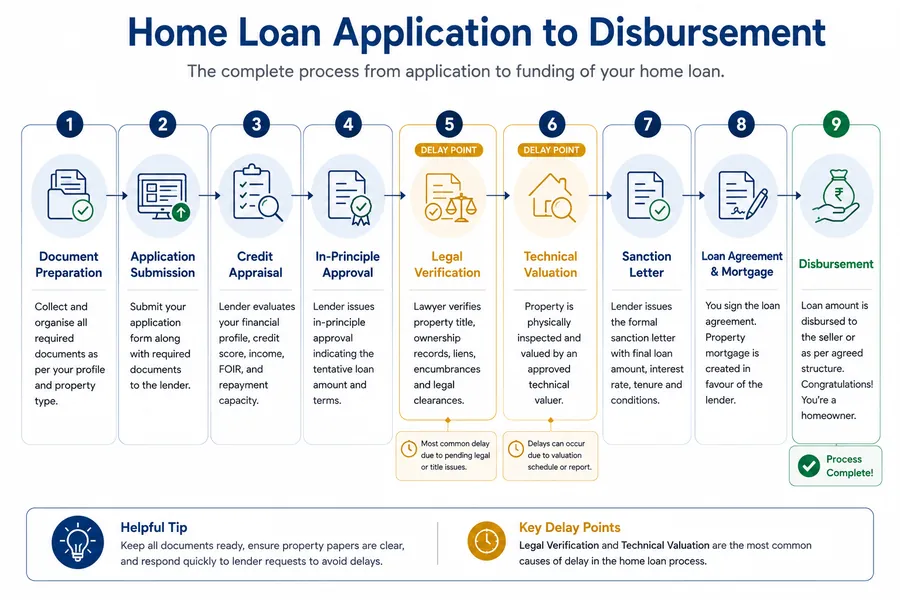
Where delays actually happen: Credit appraisal for a documented salaried borrower can move quickly — top private banks report processing in-principle approvals for prime salaried customers within a short window using account aggregator frameworks. The stages that most often extend timelines are legal verification and technical valuation, because they depend on the seller’s or builder’s documentation, not on yours.
EMI Calculator — Coming Soon
Enter your loan amount, interest rate and tenure to see your monthly EMI, total interest payable, and a full amortisation schedule. This tool is in development. Once live, this notice is replaced with the working calculator embed — the surrounding editorial text does not change.
Frequently Asked Questions
The questions below are the ones borrowers ask most often at the start of the process.
What is the minimum salary required for a home loan in India?
There is no single minimum salary set by any regulation. Each lender sets its own threshold, and these vary from around ₹10,000 to ₹25,000 per month depending on the lender and the city. What matters more than the threshold is your net surplus after existing EMIs, because that is what determines your actual eligibility.
Does the bank use my gross salary or net salary?
Lenders use net take-home salary after statutory deductions such as provident fund, professional tax and income tax. Gross salary is not used for the FOIR calculation.
What CIBIL score do I need for a home loan?
A score of 750 or above is widely treated as the industry benchmark for the best pricing. Many lenders consider applications from 700 upwards, and some housing finance companies consider lower scores at risk-adjusted rates. Exact cut-offs are lender policy and several lenders do not disclose them publicly.
Will a 650 credit score definitely mean rejection?
Not necessarily, but it does mean enhanced scrutiny. Possible outcomes include a lower LTV, a higher interest rate, or a requirement for a strong co-applicant. Approval remains at the lender’s discretion.
Can I get a home loan if my salary is paid in cash?
Mainstream banks generally decline cash-salary applications because income cannot be verified through banking channels and Form 16 is unavailable. Certain affordable housing finance companies operate assessed-income programmes for such profiles, usually at higher interest rates and with conservative FOIR limits.
How much loan can I get on a ₹50,000 salary?
At a 50 per cent FOIR with no existing EMIs, the available EMI would be ₹25,000. Over 20 years at an illustrative 9 per cent, that supports approximately ₹28 lakh. The actual figure changes with tenure, interest rate, existing EMIs and the lender’s own policy. You may be eligible for an amount in this range, subject to the lender’s assessment.
Can I add my non-working wife as a co-applicant?
Yes. A non-working spouse can be added as a co-applicant or co-owner, though this will not increase your eligibility because there is no income to club. It is generally done for ownership and succession reasons, and because many lenders require all co-owners to be co-applicants.
Do banks consider rental income for eligibility?
Rental income from properties you already own can be considered when it is documented through a registered rent agreement and reflected in your ITR and Form 26AS. Treatment varies by lender, and expected rental income from the property being purchased is treated far more cautiously.
Why was my loan rejected even though my FOIR was within limits?
FOIR is only one of six eligibility pillars. Rejection can result from credit history issues, unverifiable income, employment instability, or a problem with the property’s legal title or valuation, regardless of a comfortable FOIR.
Does prepaying my car loan increase my eligibility immediately?
Closing a loan removes that EMI from your fixed obligations, which increases the EMI capacity available for the home loan. The improvement in eligibility is immediate in arithmetic terms, but you must obtain a no-dues certificate and allow time for the closure to reflect in your credit bureau report.
Can I get 100 per cent financing for my home?
No. RBI LTV caps require you to fund at least 10 to 25 per cent of the property value from your own resources, depending on the loan bracket. Stamp duty and registration charges are generally additional and are not funded by the loan.
How long is a sanction letter valid?
Sanction letters are conditional and time-bound, typically valid for a period such as three to six months. The exact validity is stated in the letter and varies by lender.
Glossary of Key Terms
The terms below appear throughout this guide and in every lender conversation you will have.
FOIR (Fixed Obligation to Income Ratio) — The percentage of net monthly income consumed by total debt servicing, including the proposed home loan EMI.
LTV (Loan to Value) — The ratio of the loan amount to the appraised value of the property. Capped by RBI regulation.
Margin Money — The mandatory down payment funded from the borrower’s own resources, bridging the gap between property cost and the lender’s maximum funding.
MODT (Memorandum of Deposit of Title Deeds) — The legal instrument used in India to create an equitable mortgage by depositing title deeds with the lender.
Sanction Letter — The lender’s conditional written commitment setting out the approved loan amount, interest rate and tenure.
In-Principle Approval — A preliminary sanction based on income and credit history alone, pending legal and technical clearance of the property.
Technical Valuation — Physical inspection by a lender-empanelled engineer to confirm boundaries, construction quality, plan compliance and market value.
Legal Search Report — Title verification by a lender-empanelled advocate tracing the property’s ownership history, generally over 13 to 30 years.
Co-applicant — An additional borrower on the same loan who shares full repayment responsibility and whose income may be clubbed to enhance eligibility.
Hard Enquiry — A credit bureau check initiated by a lender when you formally apply for credit. Multiple hard enquiries can lower your score.
Soft Enquiry — A credit check you initiate on your own report. It has no effect on your score.
DPD (Days Past Due) — A credit report marker showing how many days a payment was delayed.
External Benchmark, Repo Rate and EBLR — An external benchmark is a publicly available reference rate to which floating rate retail loans must be linked under RBI rules. The Repo Rate, the rate at which the RBI lends short-term funds to commercial banks, is the benchmark most commonly used. The resulting rate on your loan is the External Benchmark Lending Rate (EBLR) — the benchmark plus the individual lender’s own spread.
Related reading
- Explore the full Home Loan Glossary →
Editorial Notes and Limitations
Finally, a note on how to weigh everything above.
This guide distinguishes clearly between four categories of information, and readers should note which applies to any figure they rely on:
- RBI regulations — binding on all regulated lenders. LTV caps, external benchmark linking, restrictions on foreclosure charges for floating rate individual loans, fortnightly credit information reporting, and the release of original property documents after closure all fall in this category.
- Government policy — schemes and incentives, which change with budget and policy cycles.
- Individual lender policies — FOIR limits, minimum income, minimum credit score, maximum age at maturity, the spread added above the external benchmark, and the treatment of variable and informal income. These differ between lenders and are revised commercially without public announcement.
- Industry practice — widely followed conventions such as the notional 5 per cent EMI on credit card outstandings, or the two-year work experience expectation. These are common but not universal.
Confidence assessment applied to this guide:
| Area | Confidence | Reason |
|---|---|---|
| RBI LTV regulations and FOIR mechanics | High | Sourced from central bank norms and standardised banking practice |
| RBI credit reporting and document release rules | High | Verified against current RBI directions during regulatory review |
| Baseline documentation requirements | High | Broadly consistent across lenders |
| Lender-specific age, income and tenure criteria | Medium | Commercial policies subject to unannounced revision |
| HFC and NBFC underwriting exceptions | Low | Internal risk matrices are not publicly disclosed and vary regionally |
Interest rates: No current interest rates are quoted in this guide. All rates shown are explicitly labelled as illustrative and are used only to demonstrate the arithmetic. Home loan rates are linked to external benchmarks and change over time. Always confirm the applicable rate directly with the lender.
Nothing in this guide constitutes a commitment, an offer, or a prediction of approval. Eligibility can only be determined by a lender through its own credit appraisal, legal verification and technical valuation. Where this guide says a borrower “may be eligible”, it means exactly that — subject to the lender’s assessment.
Review schedule: Regulatory sections are reviewed periodically against current RBI Master Directions. Lender criteria and any rate-linked content require more frequent editorial review.
Related guides across the site
- Read our complete FOIR Guide →
- Learn about Home Loan Documents →
- Explore our CIBIL Score Guide →
- Calculate your EMI →
- Compare Home Loan Interest Rates →
- RBI LTV Guidelines and Margin Money Explained →
- Home Loan Eligibility for Self-Employed Borrowers →
- Step-by-Step Guide to Adding a Co-Applicant →
- Bank vs NBFC Home Loan: Which Should You Choose →
- NRI Home Loan Eligibility →